 minipod.io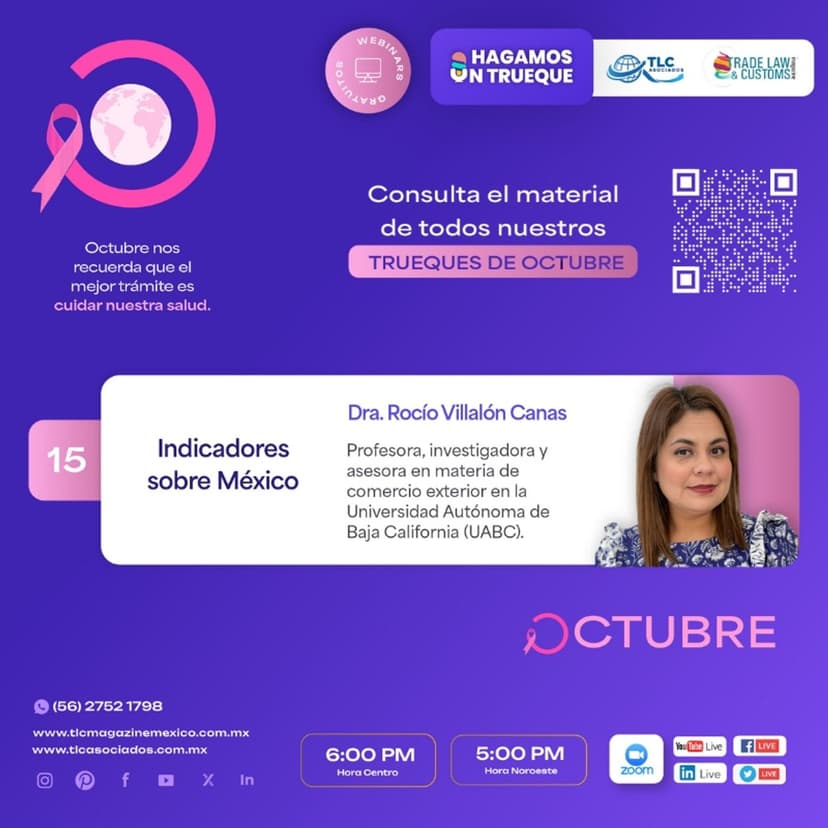
630 - Indicadores sobre México
Episode Snapshot
The transcription is a bilingual Spanish-English podcast episode titled "Hagamos un Trueque" from Telese Magas in Mexico, hosted by an unnamed presenter. It opens with promotional content for Honda...
Quick Summary
Key Points
- The transcript begins with a promotional segment for Honda vehicles (Pilot, CRV, Passport) and Sherwin Williams paint, followed by a transition to a podcast called "Hagamos un Trueque" focusing on trade, taxes, and customs.
- The podcast host introduces Dr. Rosio Villalón, an expert in foreign trade and professor at the Autonomous University of Baja California, who discusses key indicators of Mexico.
- A brief campaign for breast cancer awareness is presented, emphasizing support networks, early detection (95% survival rate), and practical advice for caregivers.
- Dr. Villalón provides general data on Mexico: population 129.6 million, area 1.96 million km², capital Mexico City, official language Spanish, currency Mexican peso, and a federal democratic republic.
- Economic context: GDP $1.79 trillion, GDP per capita $13,940, growth rate 3.2% (2023), inflation 5.1%, key sectors include manufacturing (automotive, electronics), oil/gas, services, and agriculture.
- Cultural aspects: 77.7% Catholic, important values like family, collectivism, hierarchy, and hospitality; gastronomy (tacos, mole, pozole) and cultural exports (mariachi, lucha libre, cinema).
- Key economic sectors: Mexico is the 9th largest exporter globally, 4th in automotive exports; sectors include energy (Pemex, new refinery exports), technology/manufacturing (electronics, aerospace), and agroindustry (avocado, beer, tequila, citrus).
- Opportunities: expanding advanced manufacturing, integrating supply chains post-COVID, agro-food trade, renewable energy. Challenges: corruption, security, uneven infrastructure, regulatory barriers.
- Regional negotiation styles: North (direct, contract-oriented, influenced by US culture), Center (balanced, trust-focused, mestizo heritage), South (indirect, prioritizes personal bonds, indigenous customs).
- Main trade partner: US (81.3% of exports in 2023, $503 billion), followed by Canada (3%), China (1.5%), and North America overall (86.9%).
- Rankings: Mexico ranks 6th in the World Tourism Barometer, with strong international tourist arrivals and revenue.
Summary
The transcription is a bilingual Spanish-English podcast episode titled "Hagamos un Trueque" from Telese Magas in Mexico, hosted by an unnamed presenter. It opens with promotional content for Honda vehicles (Pilot, CRV, Passport) and Sherwin Williams' Emerald Symmetry paint, emphasizing durability and coverage. The host then transitions to the main segment, introducing Dr. Rosio Villalón, a professor and researcher in foreign trade at the Autonomous University of Baja California, with extensive experience in logistics, sales coordination, and academia. Before her presentation, the host briefly promotes a breast cancer awareness campaign for October, highlighting the importance of support networks, early detection (95% survival rate), and practical tips like listening without judgment, offering help, and caring for caregivers.
Dr. Villalón's talk focuses on key indicators of Mexico, providing a comprehensive overview. She starts with general data: official name (United Mexican States), capital (Mexico City), population (129.6 million as of 2024), area (1.96 million km²), language (Spanish, with emphasis on protecting indigenous languages), currency (Mexican peso), and government type (federal democratic republic, noted for electoral transparency). Current president is Claudia Sheinbaum, who took office in October 2024.
Economically, Mexico has a nominal GDP of $1.79 trillion and GDP per capita of $13,940 (2023 data from the IMF and World Bank). Growth was 3.2% in 2023 but currently below 2%. Inflation averaged 5.1% in 2023 (Bank of Mexico). Key GDP contributors are manufacturing (especially automotive and electronics), oil/gas, services, and agriculture. Culturally, 77.7% of the population is Catholic, with strong values like family, collectivism, hierarchy, and hospitality. Festivities include Independence Day (September 16) and Day of the Dead (November). Gastronomy (tacos, mole, pozole, tamales) and cultural exports (mariachi, lucha libre, cinema icons like Pedro Infante and Cantinflas) are globally recognized. Mexico ranks 10th in global tourism, with 10 restaurants recognized in 2024.
Key economic sectors position Mexico as the 9th largest exporter globally (WTO 2023), 4th in automotive exports. The energy sector includes Pemex and new refinery exports (e.g., coke to India). Technology/manufacturing focuses on electronics and aerospace, while agroindustry exports avocado, beer, tequila, and citrus. Opportunities include expanding advanced manufacturing, integrating supply chains post-COVID, agro-food trade, and renewable energy. Challenges involve corruption, security risks, uneven logistics infrastructure, and regulatory barriers.
Dr. Villalón describes regional negotiation profiles: Northern Mexico (direct, contract-oriented, influenced by US culture, uses English-Spanish mix), Central Mexico (balanced, trust-focused, emphasizing relationships and mestizo heritage), and Southern Mexico (indirect, prioritizing personal bonds, with indigenous customs and local governance). She cites Octavio Paz's works to highlight cultural identity differences.
Trade data from 2023 shows heavy dependence on the US (81.3% of exports, $503 billion), followed by Canada (3%) and China (1.5%). North America accounts for 86.9% of trade. Mexico's strategic location reduces logistics costs, but competing in other markets (Asia, Europe, Latin America) is challenging due to higher costs and cultural barriers. The US remains a key market due to high per capita income ($60,000–$79,000) and consumer demand.
Rankings include 6th in the World Tourism Barometer (based on international arrivals and revenue). Dr. Villalón concludes by inviting questions from the audience, emphasizing Mexico's unique blend of tradition and modernity in global trade.