 minipod.io
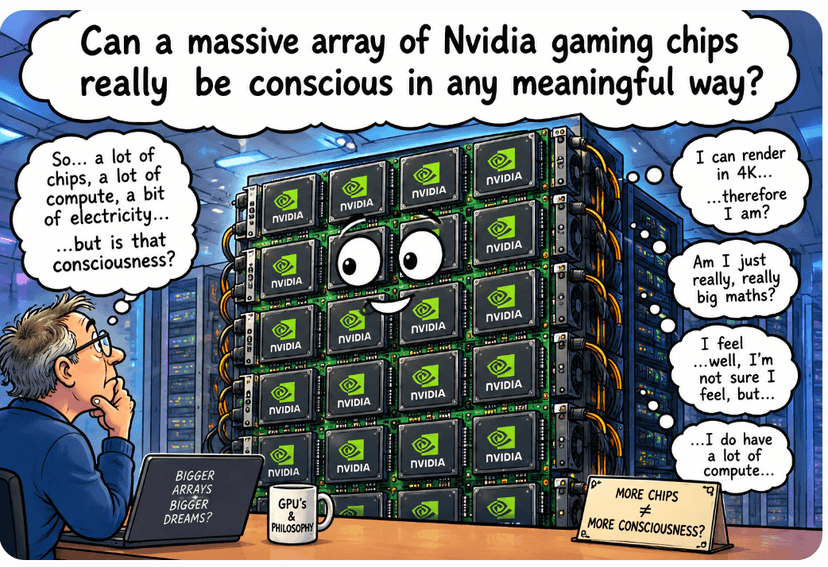
Can an array of Nvidia chips really be conscious? And kill us all?
Episode Snapshot
This podcast episode features a conversation between host Chris and Professor Shane O'Mara, a neuroscientist at Trinity College Dublin, about consciousness and whether artificial intelligence systems...
Quick Summary
Key Points
- The podcast features neuroscientist Shane O'Mara discussing consciousness and AI.
- O'Mara argues AI systems like LLMs are unlikely to achieve human-like consciousness because language is not necessary for consciousness (evidenced by aphasia patients and non-human animals).
- Consciousness is difficult to define, but involves being awake, aware, and responsive; it may never be fully explained by physical processes alone.
- Neurological phenomena like out-of-body experiences, blindsight, and cerebral achromatopsia reveal how brain damage alters conscious perception.
- The host's colorblindness illustrates the subjective nature of conscious experience—labeling a color doesn't mean seeing it the same way as others.
- AI processes color and other inputs through pattern matching and prediction, not conscious awareness.
Summary
This podcast episode features a conversation between host Chris and Professor Shane O'Mara, a neuroscientist at Trinity College Dublin, about consciousness and whether artificial intelligence systems can or will ever achieve it. The discussion takes place amid widespread debate about AI posing an existential threat to humanity, but the host steers the conversation toward fundamental neuroscience and philosophical questions about the nature of consciousness itself.
O'Mara begins by noting that consciousness is difficult to define, with no universally agreed definition. He explains that while consciousness and language are closely tied in humans, language is not necessary for consciousness. He cites patients with primary progressive aphasia, who lose language capabilities but remain clearly conscious, as well as non-human animals like chimpanzees, rats, and dogs, which lack human language but are widely considered conscious. This undermines the idea that scaling up language-based AI systems like LLMs could produce genuine consciousness.
The conversation explores two broad theoretical camps regarding consciousness: one that views it as purely biomechanical, explainable through physical brain processes, and another that argues something more exists beyond measurable neural activity. O'Mara leans toward elements of both, suggesting that while we may eventually identify the neural correlates of consciousness—such as those involved in wakefulness, sleep, anesthesia, and coma—we may never fully explain the subjective, first-person experience of being conscious. He references Thomas Nagel's famous essay "What Is It Like to Be a Bat?" to illustrate the problem of subjective experience, or phenomenal consciousness.
The discussion then turns to fascinating neurological phenomena that illuminate how consciousness works. Out-of-body experiences can be induced by damage to or stimulation of the temporal parietal junction, and virtual reality setups can make healthy people feel they've left their bodies. Blindsight patients can detect movement in visual fields where they report seeing nothing, showing that some visual processing occurs without conscious awareness. Cerebral achromatopsia, a loss of color vision from brain damage, further demonstrates how conscious perception depends on specific brain regions.
The host shares his own experience of total colorblindness, raising the philosophical puzzle of whether the "red" he has learned to label is the same red others perceive. He describes using AI to pick paint colors and discovering that AI doesn't "see" color at all—it analyzes wavelengths and matches them to training data through prediction algorithms. This highlights a key distinction: AI processes information without any conscious awareness, while human perception, even when atypical, is rooted in subjective experience.
O'Mara concludes that while we might one day build robots that appear self-aware, we may never understand how they experience the world—or whether they truly do. The conversation underscores the deep mystery of consciousness and the gap between information processing and subjective awareness.